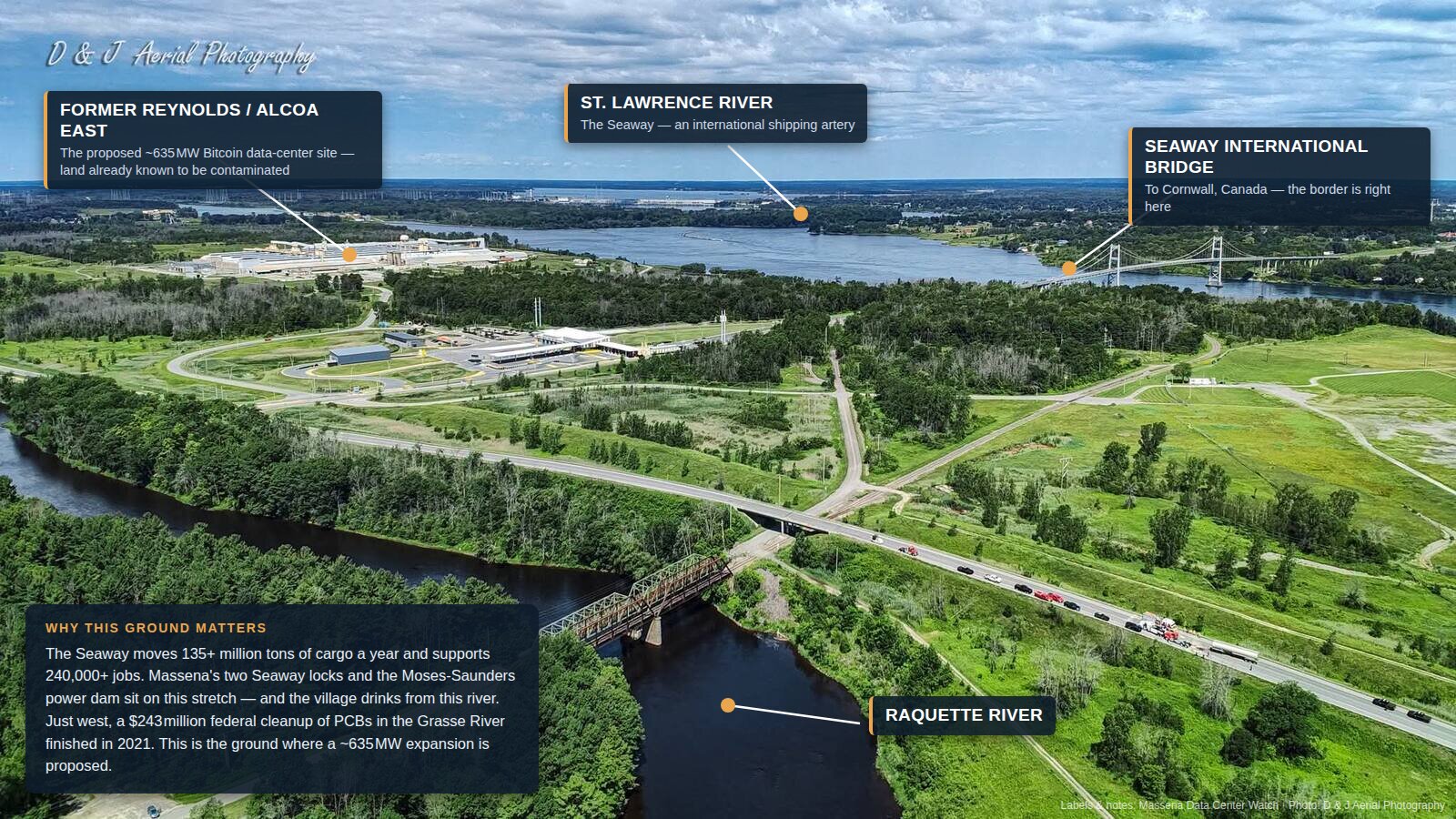
A Bitcoin-mining and data-center operation has run on the old Reynolds / Alcoa East site in Massena since 2017. The company behind it now wants to expand it to 635 megawatts—one of the largest such operations in the country—on the bank of the St. Lawrence River, in our town.
We're neighbors following that proposal. Find the public record, understand what's at stake, and make your voice heard.
Each one is laid out with its source on the Resources page — and each one is a reason this deserves the full study, not a rushed sign-off.
01
It sits on contaminated ground
The site is contaminated former-smelter land — PCBs, dioxins, and metals capped and contained in place, right beside a federal river cleanup. Heavy construction raises real questions about whether that cap stays intact.
A 635-MW load is enormous. Massena runs on cheap, town-owned power (Massena Electric Department) — the same kind of low-cost public power Plattsburgh, NY had before a crypto operation scaled up there, ate into it, and residents' bills rose. Plattsburgh became the first in the U.S. to pause mining. Who pays for grid upgrades here, and what happens to our rates?
635 megawatts is enormous. Coinmint projected more than 150 Massena jobs within 18 months. The public record shows 65 employees in 2020 and about 60 today. Now the company projects 200 employees, alongside up to two years of heavy construction on contaminated former-smelter land beside a federal river cleanup. Another projection is not enough. Put the jobs, deadline, public reporting, and consequences for falling short in writing.
The official record is still moving. Here is what the newest local information proves — and what it does not.
· October 21 Town minutes reviewed
Massena brings in outside lawyers and engineers for NYDIG review
Massena's Town Board approved legal help from Hancock Estabrook LLP and engineering review by Nussbaumer & Clarke for the NCCS/NYDIG application on October 21. The legal rates are $400 an hour for partners and $300 for associates; the engineering proposal covers application review and procurement of specialty review consultants. Read the update.
November 4 hearing concerns the Town's preliminary budget
The Town's legal notice confirms a public hearing on its preliminary 2027 budget for November 4 at 4:30 PM in Town Hall Room 30. The preliminary budget is available for inspection at the Town Clerk's office during regular office hours, and residents may speak for or against its items at the hearing. This notice concerns the Town budget, not a data-center hearing or project approval. Read the official budget-hearing notice.
· Town budget rescheduling notice reviewed
Budget meeting moved to October 28 at 4:30 PM
The Town's separate news notice confirms that the Highway Department, Airport and Museum budget meeting was moved from October 22 to October 28 at 4:30 PM. The notice does not specify the meeting venue or announce a data-center hearing. This updates the earlier title-only listing, whose linked attachment is blank; we are not borrowing another meeting's location. Read the official rescheduling notice and the AgendaCenter attachment.
· October 15 Planning Board minutes reviewed
October 15 minutes: lead-agency packages had not been sent
The Town-posted October 15 Planning Board minutes record that the SEQRA lead-agency packages had not yet been sent as of that meeting. This dated status report does not establish subsequent dispatch or a completed environmental review.
The minutes also describe work on a second draft of data-center zoning revisions and efforts to obtain additional legal and engineering assistance. They do not record project approval or set a data-center public-hearing date. Read the official October 15 minutes.
· September 21 utility draft minutes reviewed
Draft utility minutes record NYDIG discussions, not a power deal
The Town-posted September 21 Electric Utility Board minutes are marked “Pending Approval by the MEUB.” The draft reports a discussion with NYPA and NYDIG representatives about a proposed shared-services plan involving MED relaying, NYPA metering and NYDIG interconnection.
Separately, it records a resident's energy-cost stabilization and potential refund ideas, and a staff statement that NCCS and MED staff had not discussed that program as of September 21. This dated draft does not establish a signed NYDIG power agreement, guaranteed customer savings or project approval. Read the Town-posted September 21 draft minutes (pages 3 and 6).
· October 21 Town Board agenda posted
October 21 agenda lists NYDIG legal-counsel agreement
The Town Board agenda schedules October 21 at 4:30 PM in Town Hall, 60 Main Street, Room 30. It lists a proposed agreement with Hancock Estabrook, LLP for legal counsel concerning NYDIG development and data-center applications. An agenda item is not a signed agreement or project approval.
The public hearing listed on this agenda concerns a local law to override the property-tax levy limit, not data-center approval. Read the official October 21 agenda.
· November 4 budget hearing agenda posted
November 4 hearing concerns the 2027 preliminary budget
The official agenda schedules a budget meeting and public hearing for November 4 at 4:30 PM in Town Hall, 60 Main Street, Room 30. Its stated hearing purpose is to accept the preliminary budget for fiscal year 2027. No data-center item is listed, and this agenda does not establish a budget decision. Read the official November 4 agenda.
· Planning Board agenda
October 15 agenda listed NYDIG and environmental-review updates
The official October 15 agenda scheduled the Planning Board meeting for 5:00 PM at Town Hall, Massena, and listed updates on the NYDIG proposal, SEQRA lead-agency coordination, outside counsel, code revision and consultant review. This is a dated agenda record, not confirmation of what happened or project approval; the agenda did not list a public hearing. Read the official October 15 agenda.
· October 5 Town Board minutes posted
Budget dates approved; residents' data-center questions recorded
The October 5 minutes record approved budget sessions on October 14, 22 and 28 at 4:30 PM, and a November 4 preliminary-budget hearing at 4:30 PM. Future meeting locations are not specified in these minutes; check the Town's notices before attending. These are budget dates, not a confirmed data-center hearing.
The minutes also record residents' questions about environmental, health and taxpayer risks. Those comments are not Town findings, and the minutes record no data-center project approval. Read the Town's October 5 minutes.
· September 17 Planning Board minutes posted
Minutes document the environmental-review status as of September 17
The Town-posted minutes say the lead-agency coordination packages had not been sent as of September 17. They also record the increased $250,000 consultant escrow agreement and approval of the August 20 meeting minutes. These are dated records of that meeting, not proof of the review's status after September 17 or approval of the project. Read the official September 17 minutes →
· Tribal Council announcement
The Saint Regis Mohawk Tribe has taken a stand
The Saint Regis Mohawk Tribal Council's official release reports formal opposition to hyperscale data center development on or near southern Akwesasne and calls for meaningful consultation. We welcome that stand. Read the Tribe's official release →Read our report →
· Town Board minutes update
Town-posted minutes provide the official 2–3 roll call
The Town-posted September 16 minutes identify the votes on the proposed six-month local data-center pause: Raymond Lancto and Kristy Baker voted aye; Sam Carbone, Adrian Taraska, and Jared Hollander voted nay. The same minutes record an updated $250,000 escrow account signed by the supervisor and a group pertaining to data centers. The vote rejected the proposed pause; it did not approve a data-center project. Read the Town-posted minutes →Read the full update →
· Planning Board records
NYDIG update is on the September 17 agenda; August minutes are posted
The will cover SEQR coordination, the applicant-funded consultant escrow and amount deposited, a proposal-ranking method, an NYDIG/Coinmint presentation, and setting a public-hearing date. Newly posted August 20 minutes separately record the applicant’s revised design and financial, ratepayer, and jobs proposals; they do not record project approval. Read the September 17 official agenda →Read the August 20 minutes →
· Town Board agenda
Agenda lists the moratorium hearing and an adoption resolution
The official agenda for the lists the public hearing and a resolution to adopt the proposed six-month data-center moratorium. The agenda proves what the Board plans to consider, not what it ultimately does. Read the Town's official agenda →
· corrected proposed local law
Town corrects section numbering in the draft moratorium
The Town says the corrected draft fixes a clerical numbering error: Section 8 had been omitted and the numbering jumped from Section 7 to Section 9. The Town says no substantive language, meaning, or legal effect changed. The proposal would still pause new or enlarged data-center development for six months. Read the Town's corrected draft local law →
· Town calendar update
Town calendar updates the September 16 hearing details
The Town calendar listed the at 60 Main Street, 2nd Floor. The separate hearing notice said the 4:30 PM hearing would consider a local data-center moratorium; the September 17 reported outcome appears above. Read the Town's official calendar entry →
· official hearing notice
September 16 public hearing is official
The Town posted notice for in Massena Town Hall to consider a local law establishing a moratorium on data-center permitting or development. The notice does not state a duration, and it does not say the law has been enacted. Read the Town's official notice →
· Planning Board minutes
Minutes record the revised design, proposed payments, and board questions
The official minutes record the applicant’s revised two-building design, 64 backup generators, closed-loop cooling, and proposed host-agreement payments and ratepayer protections. Board members questioned jobs, coolant disposal, noise, batteries, taxes, and emergency planning. The meeting ended without a recorded project-approval vote. Read the official minutes →
· Town Board minutes
Residents asked for three years; the Town scheduled a hearing on six months
The official minutes describe a petition presented by Mr. Fenton as having more than 1,200 signatures supporting a three-year moratorium. That is the minutes' description, not a certified signature count. Resolution 145-2026 separately scheduled a public hearing on a proposed six-month moratorium. Scheduling a hearing did not enact the law. Read the official minutes →
Background: The local review and public response began in late June. The complete dated history remains on the record page.
You don't need to be an expert — every action here is timed so you know exactly what it costs you.
01Get on the record~3 minutesCopy the ready-made letter demanding the full study and email it to the Town Clerk. Written comments become part of the record.
02Read the official vote record~2 minutesThe Town-posted minutes now identify the 2–3 roll call and other data-center actions from September 16. See the sourced update.
03Bring five neighbors~90 secondsSend this site to five people in Massena. Eleven people in the room is how this almost slipped past everyone.