The wider picture, locally
It may not stop at one. The St. Lawrence County Industrial Development Agency’s CEO, Patrick Kelly, has said roughly 10 data-center proposals are being looked at in the area — while cautioning that “doesn’t necessarily mean all these projects are going to go forward, or any of them.” For now only the one ~635 MW project is actually advancing, but it shows the scale of what’s circling Massena. WWNY 7 News →
And there’s a nuclear plant in the mix. New York is developing an advanced nuclear plant (Governor Hochul directed NYPA to pursue at least 1 GW in June 2025), and Massena / St. Lawrence County is one of eight communities under consideration to host it; NYPA and Ontario Power Generation signed an agreement on Dec 19, 2025 to cooperate on siting. On Jan 20, 2026, the Saint Regis Mohawk Tribal Council and the Mohawk Council of Akwesasne jointly stated they will not support a nuclear plant “at any location near the Akwesasne Mohawk Territory.” Data-center demand and new nuclear are two sides of the same energy push aimed at this stretch of the river — and the Mohawk community has already said no to the nuclear piece. North Country Now → · NYPA → · Tribal statement →
What's downstream: the river flows east — toward Akwesasne
The St. Lawrence at Massena isn’t a clean slate. The EPA’s own name for this stretch is the St. Lawrence River (Massena/Akwesasne) Area of Concern — a federally designated river cleanup, because of the PCB and metal contamination left by the former Reynolds/Alcoa and GM industrial sites. The river here is still under fish-consumption advisories. EPA →
And the river flows east. From Lake Ontario the St. Lawrence runs northeast toward the Atlantic — so anything stirred up during construction, or discharged as warmed cooling water at the old Reynolds/Alcoa site, moves downstream, away from Massena and toward the Akwesasne Mohawk Territory, which straddles the river along the New York–Ontario–Quebec border just below the site. That is no accident of naming: the EPA cleanup is co-managed with the Saint Regis Mohawk Tribe — the contamination legacy of these sites has always been a Massena and Akwesasne burden, because the current carries it their way. EPA boundary map →
The downstream interests of Akwesasne must be part of environmental review. In its October 2 announcement, the Saint Regis Mohawk Tribal Council opposed hyperscale data center development on or near southern Akwesasne and identified concerns about water, energy demand, air quality, noise, light, the economy, and cultural resources. Those are the Council's stated concerns, not a comparative finding about which community would suffer most.
What's there now vs. what's proposed
The company says it has operated on the site since 2017 (the operation was previously known as Coinmint), employing about 60 people.
What's proposed, in the company's current words, is to "expand and modernize" the campus to roughly 635 megawatts of power capacity — and grow to about 200 employees, with 1,800 to 2,000 workers at peak construction over roughly two years. The current project page describes two data halls. Every one of the company's claims is quoted, conceded where true, and questioned where unproven on What They Say.
Where
The site is 182 & 194 County Road 45, Massena — the former Alcoa East / Reynolds aluminum-smelter campus on the St. Lawrence River. That address is stated verbatim in the town's own May 21, 2026 Planning Board minutes.
How big — what current sources actually say
Power use for a project like this is measured in megawatts (MW). These are the current, attributed project figures:
- The May 21 Town minutes record the company's expansion figure as roughly 635 MW, described there as 435 MW approved plus 200 MW pending.
- The company's current project page describes two new data halls, replacing an earlier three-building design.
- The same current company page lists 64 emergency generators for standby use and periodic testing, not normal operation.
Where it is in the process — right now
This is the part that matters most, because it's where the public still has leverage.
- The review has barely started. This is a SEQR review (the State Environmental Quality Review — New York's environmental-review law). As of late June 2026, no "determination of significance" has been made. That determination is the fork in the road: a Positive Declaration forces a full Environmental Impact Statement (EIS) — a deep, public study — while a Negative Declaration ends the deep review. Neither has happened yet.
- The board's own chair confirmed how early it is. Planning Board Chair Vance Fleury said, "We have not even set up for a preliminary site plan." The developer's own attorney called the SEQR review "just the beginning."
- It is moving through the machinery. At the June 25 Planning Board meeting the board discussed hiring consultants and started the lead agency process for the SEQR review. It also voted to refer the project to the Zoning Board of Appeals — to settle whether a data center is even a permitted use in an Industrial zone. The motion carried 4–0, with one member abstaining. This is in the town's official minutes. Read the June 25 minutes →
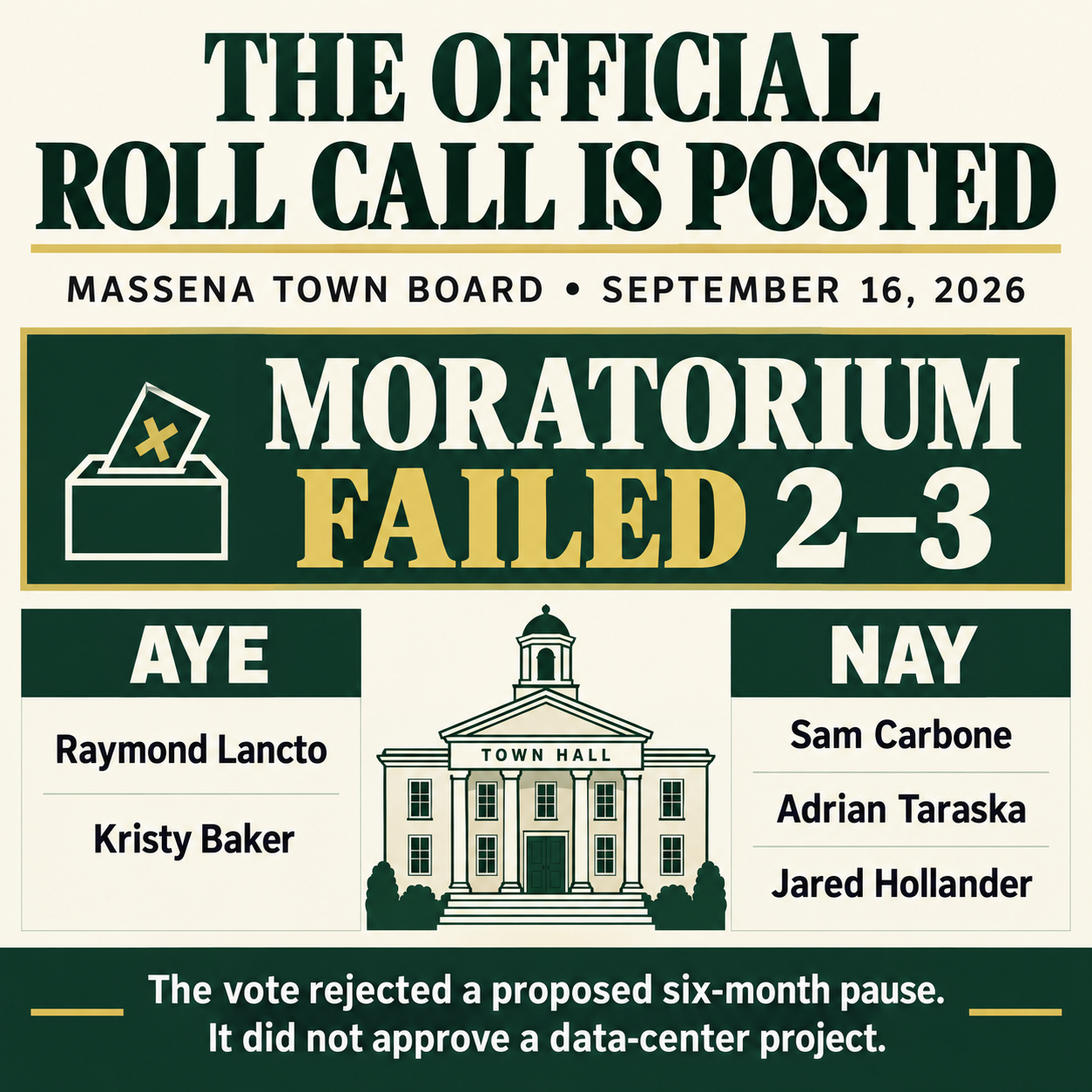
- The moratorium hearing has been held. Town-posted minutes show Resolution 147 failed 2–3: Lancto and Baker voted aye; Carbone, Taraska, and Hollander voted nay. The vote did not approve the project, and the board has said multiple public hearings must happen before any project approval.
Bottom line: the decisions that matter haven't been made. "Get informed and show up" is not too late — it's exactly on time.
Why a 635-megawatt meeting drew about 11 people
The June 25 meeting was a make-up date — and the way it was noticed is a big part of why almost no one was in the room. From the town's own website and its RSS feed:
- The Planning Board's regular June 18 meeting was scheduled, then cancelled — but per the town's RSS feed, the cancellation notice wasn't posted until June 22, days after the original meeting date.
- The make-up meeting was set for June 25. Its agenda first went online roughly a day ahead — dated "Thursday, June 26" (the wrong date), with no room listed — then was quietly swapped about 90 minutes later for a corrected version (June 25, Room 30). We could find no louder, separate notice that the date and room had changed.
- The data-center item itself was inside a PDF, not searchable text on the page — easy to miss for anyone watching the site.
We are not accusing anyone of breaking the law. But a cancelled-then-rescheduled meeting, noticed roughly a day ahead, first mis-dated, with the key item buried in a PDF, is how a decision this big ends up in front of about 11 residents (a figure from a resident's account of that night). See the agendas and timestamps for yourself →
What it means for residents
Three concerns hold up under scrutiny. We state each one honestly, including its limits.
1. It would be built on contaminated ground
The site is former-smelter land carrying PCBs, PAHs, dioxins, and metals that were capped and contained in place under federal cleanup, right beside a monitored river-sediment cap. Heavy construction — excavation, grading, dewatering, stormwater — raises real questions about whether that cap stays intact. To be accurate: this is contaminated former-smelter land beside a federal river cleanup, not a listed Superfund/NPL site.
We ask that the EIS study cap integrity, soil handling, dewatering, and stormwater control.
2. Your electric bill
A 635 MW load is enormous. Massena isn't on some shared statewide grid where the risk is diffuse — Massena Electric Department (MED) is a municipal utility that buys cheap, locked-in NYPA hydropower, with rates that rank in the lowest 10% nationally. That's exactly the kind of cheap public-power supply Plattsburgh, NY had before a crypto operation scaled up there, ate into the cheap allocation, and pushed the city over quota — residential electric bills spiked and the city became the first in the U.S. to pause crypto mining. The company says it pays "full market rates" and gets "no discounted power."
We ask who pays for any grid upgrades, what it does to local rates, and how many permanent jobs each megawatt actually buys.
Sources: Massena Electric Department, the Plattsburgh precedent, and the full citations →
3. Around-the-clock noise
Operations like this are loud. The company told the board its studies show 40 dB at the nearest homes — "comparable to a refrigerator hum." But 40 dB is already at the threshold where the World Health Organization says nighttime noise begins to harm health. And at a comparable facility in North Tonawanda, NY, the police chief's two-week study found the crypto plant exceeded the city's 50 dB nighttime limit every night — drawing four citations in July 2024, after which the city passed a two-year moratorium on new crypto mining. We are not measuring Massena here — North Tonawanda is the comparison, a warning of what these facilities do.
We ask for worst-case, nighttime acoustic modeling at the property line, measured against state and local limits — not a single reassuring number.
Ready to do something about it? Here's how to be heard →